
Quick Answer: Coating cylinders apply varnish, lacquer, and functional coatings — such as gloss finishes, heat seal lacquer, and moisture barriers — to printed or unprinted substrates. They differ from print cylinders because their cell structure is engineered for even fluid deposition rather than image reproduction.
Not every cylinder on a rotogravure press carries ink. Coating cylinders apply varnish, lacquer, and protective finishes that determine how a finished product looks, feels, and performs after it leaves the press. Kanodia Gravure manufactures coating cylinders engineered for precise, consistent deposition, helping packaging and printing companies add gloss, protection, and barrier properties to their products with complete reliability.
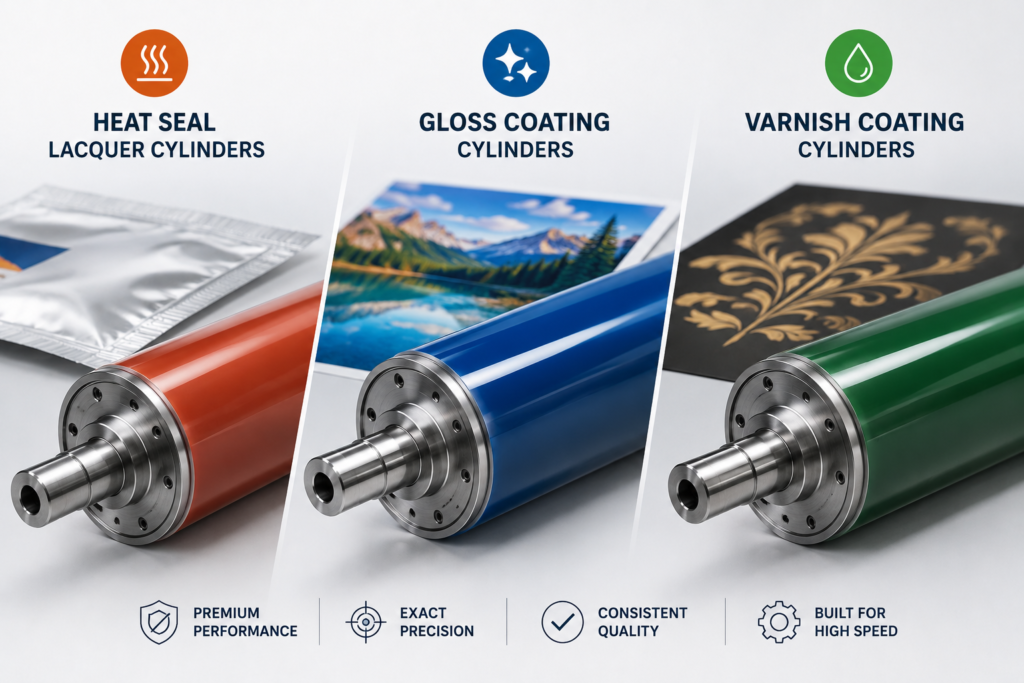
What Coating Cylinders Are and How They Work
A coating cylinder transfers a thin, controlled layer of liquid coating onto a substrate as it passes through the press, much like a print cylinder transfers ink, except the goal is uniform coverage rather than an image. The cylinder’s cell pattern and depth are engineered specifically for the viscosity and chemistry of the coating being applied, so the substrate receives a consistent layer from edge to edge and from the start of the run to the end.
Types of Coatings Applied Using Coating Cylinders
Coating cylinders handle a wide range of applications depending on the substrate and end use. Gloss and matte varnishes enhance the visual appeal of printed packaging. Heat seal lacquer (HSL) coatings allow flexible packaging to seal properly during pouch or sachet formation. Moisture barrier coatings protect food packaging from humidity and contamination. Functional and protective coatings improve resistance to abrasion, chemicals, and environmental wear.
Our coating cylinders work with UV-curable, thermal-setting, and water-based coating systems, giving converters flexibility across different production technologies and substrate types.
Why Precision Matters in Coating Cylinder Engineering
Coating thickness directly affects performance. Too little coating, and a heat-seal layer fails to bond properly, or a moisture barrier underperforms. Too much coating wastes material and can affect drying time, finish quality, or seal strength. Our coating cylinders deliver high deposition accuracy, achieving dry coat weights of up to 5gsm with minimal variance across the surface, so converters get the same performance from the first metre to the last.
This precision starts with the cell geometry. Our engineering team designs cell depth and pattern specifically for each coating’s viscosity and chemical composition, then validates the design through testing before full production begins.
Coating Cylinders for Gloss, Matte, Satin and Textured Finishes
Beyond function, coating cylinders shape how a product looks and feels on the shelf. A gloss finish increases shine and visual impact for premium packaging. A matte or satin finish creates a softer, more tactile feel that many brands prefer for a premium positioning. Textured coatings add a physical dimension that printed graphics alone cannot achieve. We engineer cylinders for all of these finishes, working closely with brand teams and printers to match the exact look a product needs.
Industries That Use Coating Cylinders
Packaging companies use coating cylinders extensively for food, FMCG, and pharmaceutical products that need protective and barrier coatings. Printing and graphic arts businesses use them for varnishing and finishing commercial print work. Textile and electronics manufacturers also rely on coating cylinders for functional surface treatments where protection or specific surface properties matter more than visual print quality.
Within food packaging specifically, coating cylinders apply oxygen and moisture barrier layers that extend shelf life on snack pouches and dry-food packs, while heat seal lacquer cylinders make sure flexible pouches form a reliable seal at high filling-line speeds. In commercial print and labels, coating cylinders apply spot or overall gloss varnish that lifts a design’s shelf appeal without the cost of a separate lamination step. Each application calls for a different cell structure, which is why a coating cylinder cannot simply be treated as a smaller, simpler version of a print cylinder.
How to Select the Right Coating Cylinder Manufacturer
Choosing a coating cylinder supplier requires evaluating more than price. Confirm the manufacturer can engineer cell structures for your specific coating chemistry, ask about their dry coat weight accuracy and consistency testing, and check whether they offer consultation support to help match cylinder specification with your coating formulation and press conditions. A manufacturer who understands coating chemistry as well as cylinder engineering saves significant trial-and-error time on your production line.
Kanodia Gravure brings both disciplines together. Our team has manufactured precision cylinders since 2006, backed by the 30-year packaging and printing expertise of the Kanodia Technoplast group, including deep experience with high-barrier films and specialised coatings. We use Daetwyler engraving and plating systems to hold tight tolerances on every coating cylinder, and our quality control process checks dimensional accuracy and surface treatment at the micro level before any cylinder leaves our Delhi facility.
Talk to Our Team About Your Coating Cylinder Requirements
Whether you need a gloss finish, a functional barrier coating, or a custom textured surface, our engineers can design a coating cylinder that fits your exact production line. Contact Kanodia Gravure to discuss your coating chemistry and substrate requirements, or use our Cylinder Price Calculator for a quick estimate.
Frequently Asked Questions
What is the difference between a coating cylinder and a print cylinder?
A print cylinder reproduces an image using cells engraved to hold ink in a specific pattern. A coating cylinder uses a uniform cell structure designed to deposit an even layer of liquid coating across the entire surface.
What dry coat weight can your coating cylinders achieve?
Our coating cylinders are engineered for high deposition accuracy, achieving dry coat weights of up to 5gsm with minimal variance across the surface.
Can coating cylinders be customized for a specific coating formulation?
Yes, we design cell depth and pattern around your coating’s viscosity and chemical composition, then validate the design through testing before full production to ensure consistent results on your line.
What types of coatings can your cylinders apply?
Our coating cylinders apply gloss, matte, satin, and textured varnishes, heat seal lacquer, moisture barrier coatings, and other protective or functional coatings, depending on your substrate and end-use requirement.
Do coating cylinders work with UV-curable coatings?
Yes, our coating cylinders support UV-curable, thermal-setting, and water-based coating systems, so they integrate with most modern coating technologies used in packaging and print production.
How do I know which coating cylinder specification I need?
Share your substrate, coating chemistry, target coat weight, and press details with our team. Our engineers recommend the right cell structure and specification based on your production requirements.
